Monday, 14 March 2016

Design Brief - Part 2, OCCUPANCY

Design Brief (II)


Occupancy

At any one time, the home will be occupied by 4 adults and 2 children. We would like to cater for the future and provide for an extra kid or house guests with a flexible 5th bedroom. Some styles, features & requirements follow:


Master Bedroom

Style: Tropical Chic meets luxury Americana. (More Westin than Ritz Carlton)
Ensuite requirements: Twin vanity with seperate WC and wetroom
Wardrobe: Walk-in wardrobe, island storage, bench seating 
Bedding:King
Additional requirement: an adjacent living area with TV would be a plus 


Wetroom:


Senior Suite

Style: Clean lines, functional luxury
Ensuite requirements: Yes - senior friendly
WardrobeBuilt-in full length wardrobe
Additional Carpentry: Attached TV console to wardrobe
Bedding: Queen
Additional Requirement: Must be senior friendly. Access to main road without stairs; possible need for wheelchair in future


Kids Room 1

Style: Functional space for a 9 year old going on 18.
Ensuite requirements: Ensuite if possible, otherwise "Jack and Jill" ensuite preferred
Wardrobe: Built-in full length wardrobe
Additional Carpentry: Platform bed 
Bedding: Super Single - Queen
Additional Requirement:


Kids Room 2

Style: Fun (ctional) space for a 2 year old tyrant
Ensuite requirements: Ensuite if possible, otherwise "Jack and Jill" ensuite preferred
Wardrobe: Built-in full length wardrobe
Additional Carpentry: Built in Bunk bed with slide
Bedding: Super Single - Queen
Additional Requirement: See dream pic


Guest Bedroom - Study - Kids Room 3(?)

Style: Functional space for 2 guests 
Ensuite requirements: Functional Ensuite 
Wardrobe: Built-in full length wardrobe + attached study table for 2
Additional Carpentry: Murphy bed or sofa bed as is cost effective/comfortable
Bedding: Twins. Side by side
Additional Requirement: See dream pic


Nanny's Room

Style: Functional space  
Ensuite requirements: Adjacent to utility room
Wardrobe: As is viable
Additional Carpentry: n.a.
Bedding: Single

Design Brief - Part 1, THE DESIGN

Design Brief (I)

Style

"Practical Contemporary Tropical". I've had the luxury and privilege of holidaying in some pretty spectacular hotels and villas in Asia (all reasonably priced, trust me). One of my favorites is this one. These have shaped some pretty awesome dream-homes in my head. Unfortunately, not all of them have been practical given a)how limited my budget is for this build; b) how I won't have an army of staff to help with the upkeep; c)my fairly small plot of land. So what do I mean?

Practical. The house should be easy to maintain. I love wood and would like to have this clad the entire house, but I am aware of the harsh realities of having to maintain wooden structures and/or architectural finishes. I would also like a home that offers some flexibility for current and future needs. I mean hey, kids grow up right? Also, I would prefer that the home is "idiot-proof" when it comes to maintenance - no lightbulbs I can't change without bringing in scaffolding please.

Contemporary. Below are some examples I've found from Houzz (great app btw) - sorry I know there's wood, but my point is that a) I need symmetry and regular shapes, but not necessarily monolithic ones b) classy, but not ostentatious c) plenty of light. 


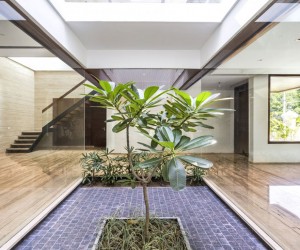
Tropical. Ah yes. Seeing how I live in the tropics, it seems to make oh so much sense. But I'd like some tropical greenery in the home (think of a Frangipani tree in a water feature in an air-well), but yet easy to maintain.  


Also, what's really important about integrating the tropics in the design, is how it needs to be manifested in the design features.

Design Features

Maximization of space. I have 2,800 sg ft of land, but there are setback requirements meaning that I'll only be able to build on ~1350 sq ft. If we are clever about it and can go about building staggered floors, it would be ideal to achieve ~4,000 sq ft of space. But again, it would very much depend on how much we can bring the costs down for a build. See previous post on costs. :(

Good ventilation + Passive cooling. This is absolutely key for the tropics. I cannot envisage having the air-conditioning on 24x7, so I need my home to be well ventilated. The problem is that my home is surrounded by houses that tower over mine. The struggle to ventilate, is therefore real. I think that one of the houses we've visited recently has addressed it somewhat - but they had the advantage of not having a house directly behind theirs. Our house is also West-South-West facing - meaning we get an awful lot of afternoon sunlight. This heats up the place so we'll need to think cleverly about how to cool the home passively.

External sunshades may prove useful for this purpose. 


Maximization of light. One of the issues I have now, is that the house is sandwiched between 2 others (wall to wall), so very little light gets into the house. When we rebuild, we will detach from one of our neighbours - and that should let some light in. However, it would be preferable to allow the maximum amount of light into every crevice of the home.


Where necessary, I would also ask that the architectural finishes (read: doors, shutters, windows) be put in place that allow for the house to be cooled with an air-conditioner or darkened to enjoy the movies. 

Design & Materials

Ultimately, it all boils down to cost. Wood & glass are expensive, I know - so I'll be happy to work within my means to find the best compromise. My preference, is to have natural (or natural looking) materials as far as possible.

I am quite happy with homogeneous tiles as long as they vaguely resemble natural stone. I love for some of my ceilings to be decked out with timbre - but I'll settle for laminate simply because I won't be able to tell the difference.

I'll also settle for aluminium in lieu of wood - but I believe that we should as far as possible be avoiding materials and finishes that don't look natural. If possible, plastic should be banned in the design.


Sunday, 13 March 2016

Questions for a Design Brief

While I had written about our wish list previously, I think it's insulting to share our plans with the architect and distort his/her view of what we want. I have instead now opted to write a design brief in parts - responding to the questions below:

DESIGN

What kind of ideas do you have about design and / or materials? 
Do you have any images from magazines/internet that show us a style that you like? 
Are there any particular design features that are important to you? 
What kind of style do you require for the project e.g.. contemporary, traditional, industrial, bold, elegant, minimal etc. 
Do you have any specific materials or surfaces in mind that you would like to see included in the project? 
Do you have specific time requirements for the project to be complete? 

OCCUPANCY

Do you have any specific accessibility requirements, for example is anyone in your family disabled or do you have any regular visitors that would have special needs? 
How much time and energy would you be willing to invest to maintain your home? 
How many people will be living in the new home? 
Describe your lifestyle and the kind of spaces that you need? For example, work from home, entertain often, etc How much time do you spend in the different areas of your home (indoors and outdoors)? 

USAGE

What type of entertainment systems do you require? 
Music, TV, projectors, speakers throughout the house? 
What type of storage do you require? 
Specific hobbies that require lots of storage space? Large wardrobe space? Number of floors / rooms / spaces and use for each? 
Are there any particular areas that are to be more private that others? 
Or particular rooms that you would like to be connected? 
Do you have any preferred room layouts/relationships or orientations – a south facing kitchen for example
Do you have any specific considerations toward sustainability and energy efficiency – is there a particular system you would like to use: i.e., solar panels etc. 

Monday, 29 February 2016

Warren's Home

People who read this blog - yes all 3 of you, would remember that we introduced you to Warren Liu in an earlier post.

One may even remember that  we found him via the Straits Times in this article.

One month after our initial meeting, Warren was kind enough to show us the house mentioned in the article. His home.

The reason why he showed us the house, was because it was a relatively modest build costing him ~$250 per sq ft.

It was a beautiful home


in hot tropical Singapore, it was a pleasure to sit in his kitchen without the fan on, and enjoy the breeze.


I wasn't a fan of the eclectic furniture choice, but only because I'm quite conservative about furniture and furnishings... but really, everything was gorgeous, given the costs.


I think I would look for alternatives in some areas... instead of aluminium shutters, maybe I would go with wooden plantation shutters... but of course the point at which we delve into the details on architectural finishing is still miles away.


The couple of things I did love:


  • The use of space - from a land area of ~1400 sq feet, he cleverly built a >3300 sq ft house
  • He managed 3 bedrooms + 2 studies (1 convertible into a guest room) + 1 utility room + a gorgeous multi-tiered open plan living area
  • a GREEN roof! like grass... on a roof!
  • Gadgets galore (thank you Sonos)
  • I was ambivalent about bringing the outdoors in, but my wife loved all the greenery
  • oh and check out the pièce de résistance... a TV in the dining table.


View professional pics of his home here.

Light-Gauge Steel Construction

So there's a slight (30-50% if we're counting) disconnect between how much money we can potentially spare and how much it would cost to build our dream house. As a consequence, we had 2 options. 1) scale back on our dream, or 2)kick the can down the road and dream a little dream at a later time.

With the latter approach, there is no guarantee we'll ever get to it... :(

So we got to thinking... and researching.

One way to get over >3000sq feet of space at under $300 per sq ft in Singapore is to find ways to cut costs. Why construction is so expensive in Singapore is because of labour.

So how do we save time & money? Alternative construction methods. Brick and mortar construction can take up to a year to complete a 3,500 sq ft home. Using light-gauge steel construction however, means that we can cut costs by over 30%... what is it?

https://www.bca.gov.sg/publications/BuildabilitySeries/others/bsl_cp9.pdf


Steel is widely used in the construction of multi-storey buildings. However, steel construction is seldom used and is traditionally considered uneconomical for landed properties. In many parts of the world, timber or structural brickwork is preferred whereas in Singapore, reinforced concrete construction is usually preferred for landed properties. Over the years, various improved systems have been developed for use in landed properties. An economical light gauge steel frame system is increasingly being used in America, Europe, Australia and New Zealand. This light gauge steel frame is developed through a cold-formed process without the use of heat. This process enables steel manufacturers to produce light-weight but high tensile steel sheets. The sheet surface is coated with a zinc alloy that completely covers the steel surface and seals it from the corrosive action of its environment. This results in buildings that are more solid, rigid, stronger, durable and easier to build. As such, the light gauge steel frame system is an attractive alternative for use in landed properties. This is particularly in view of concerns on the depletion of timber resources and low productivities associated with reinforced concrete construction. 

Over the weekend, we visited a 3 storey building that was erected in 1 month. That's right folk - an entire school block. Time being money, is finally playing in our favour.

Reservations

One of the key reservations we have about this form of construction is that impact noise is very perceptible. if you knock on the walls (made of chip board), or jump on the floor, you can hear the reverberation. This gives one the impression that it is not as sturdy as your typical reinforced concrete construction.

Also, I was asked by someone I spoke to: "if there was a riot, could someone hack into your home with an axe?" my immediate reaction was that if someone had an axe, chances are they'd be able to breach any door or window in a conventional home... but I understand where he was coming from. There is a certain disconcerting feeling around chip-board or even concrete-fibre walls when you've lived your life around concrete... maybe it's time for a change. 


light gauge steel construction in action

Monday, 1 February 2016

THE COSTS OF FINANCING A HOME (BUILD) IN SINGAPORE

Financing, Refinancing & Doing the Tango

In truth, this has nothing to do with the Tango - although conversations with banks (or rather bankers) sometimes feels like it.

Wait - let me qualify. I don't dance the Tango (or any formal dance really) because I don't like to. same way I don't like speaking to bankers, or anyone really. That's why I blog. it's sad, I know, but i digress.

To set the context,  this is what the existing (inter-bank) interest rates look like


Updates can be obtained from http://www.moneysmart.sg/home-loan/sibor-trend

It does not look good if you want a loan as we have interest rates creeping upwards.

Ok here's the deal. I have a mortgage for the existing property. The good news is, I have a property; the better news, is that the property has actually appreciated in the last 10 years. so I have a few options to extract the value from my property.

In order to get a construction loan, banks typically have given me the following terms & conditions:


Construction Loan Financing:
Up to 70%  of the construction cost and subject to approval. Construction cost must not exceed land cost

Interest charge
~6.00% Upon issuance of the Temporary Occupation Permit (TOP), the construction loan will be converted to a housing loan at the prevailing interest rate and remaining loan tenure.

Loan size
Minimum loan amount is S$200k and maximum S$2m

Loan tenure
Up to your age 65 years olf or 30 years loan tenure whichever is earlier For construction loan, project mus be completed within 24 months from 1st drawdown

Valuation
Will be conducted in 2 stages: - prior to disbursement - at TOP stage

There are a bunch of other clauses, but it's pretty boring. Bottom line is that for a $1 mil build, the cash outlay will be a whopping $300,000. I DON'T HAVE $300,000 lying around!!!! And If I did, I wouldn't te telling everyone on a blog!!! (trust me I don't)
Anyway, the alternative, is an equity based term load. ie, using the value of my property as collateral to take a loan.

Home Equity/Term Loan Financing:

There is certainly more flexibility in this, but EVENTUALLY, the interest rate would be higher than if you took a construction loan which you could convert into a home loan upon completion of the build.

One bank gave me a detailed breakdown on repayment based on a $1 mil loan. the various permutations, taking into account rising interest rates are as follows.

The repayment schedule based on a ~1% Sibor
Year
Year 1
Year 2
Year 3
Year 4...
Gross Interest Rates (p.a.)
2.43075%
2.43075%
2.43075%
2.48075%
Monthly Instalment
$3,915.30
$3,915.30
$3,915.30
$3,938.94

Over 3 Years
Over 5 Years
Over 10 Years
Over Loan Term
Total Interest Payable
$70,454.71
$115,403.34
$216,469.92
$417,165.71
Total MI Payable
$140,950.76
$235,485.20
$471,821.30
$1,417,165.71

The repayment schedule based on a ~2% Sibor

Year
Year 1
Year 2
Year 3
Year 4...
Gross Interest Rates (p.a.)
3.43075%
3.43075%
3.43075%
3.48075%
Monthly Instalment
$4,451.88
$4,451.88
$4,451.88
$4,477.42

Over 3 Years
Over 5 Years
Over 10 Years
Over Loan Term
Total Interest Payable
$99,958.22
$163,942.10
$309,712.58
$610,952.62
Total MI Payable
$160,267.69
$267,725.83
$536,371.19
$1,610,952.62


BEST OF BOTH WORLDS
So, I'm not totally convinced that we can afford this rebuild. BUT, if we did want to game it, we could take a $400k Home Equity Loan (on the pretext of "personal investments") and thereafter, take a 70% construction loan for the explicit purpose of the rebuild.

The alternative, and I am waiting for other banks to get back to me, is to refinance my mortgage completely.


THE COST OF BUILDING A HOME IN SINGAPORE

It's all about the money

Building Costs (Buildings Cost!)

According to all the architects that we have spoken to, including our top 3, mentioned here, here and here, the costs for building a bespoke home average $320-400 per square foot. So a property that has 3,500 sq feet built in (325 sq m) would cost S$1.1 mil to $1.4 mil. Someone we know, is paying upwards of $500 per sq m for an extremely luxe build.

If you want gross construction figures and statistics, you may refer to Langdon & Seah's Construction Cost Handbook. For other countries in Asia, you may download other handbooks from here. The costs here, based on Construction Floor Area (CFA) put a 325 sq m semi-detached house at $877k to $1.02 mil.

CFA of course excludes all the bits and bobs outside of the actual house (eg. garden, car porch etc.)


Of particular interest, is the breakdown of costs. turns out the bulk of the costs are in architectural finishes. So ultimately, the cost of the home is tied to the quality of the finishes and fittings.

What I'm hearing more and more is that glass is expensive. the more light you want to let in, the more it's gonna cost.


Architectural & Other Professional Fees

According to the Singapore Institute of Architects, all members (read architects) are free to set their own fees.

So we've had quite a few interesting quotes ranging from fixed fees, to percentage of total estimated build.

A ballpark for a build of our scale, is $70k-$100k in architectural fees alone.

Then there is more.

A structural engineer will likely come in at $20k

A quantity surveyor will come in at $15k (but Architects may be willing to do this for a project of this scale)

Others, including your land surveyors, clerk-of-works & soil testing could likely set you back a further $15k

Of course, you need to set aside a budget of submissions to all the authorities, and that will likely cost you $15-20k


The BIG Total

Building costs: $1mil to $1.4 mil
Professional fees: $120k - $160k
Furniture: (oh gosh! we're going to be sleeping on straw mats at this rate!!!)

S$1.2mil - S$2 mil 

ok let's see what the banks come back with!!!